Thursday, January 15, 2009

Car Accidents

Make no mistake, driving in the Arab world is dangerous and accidents are endemic. It is unfortunate and it is true; the GCC has the worst per capita ratio of road deaths record in the world. Someone once told me there had been 23,000 deaths on the roads in the Arab world in 2004 (this figure includes all countries in North Africa and the Levant).

The GCC 'grim reaper' death league table look something like this:

1. Oman; 23 deaths for each 100,000 people, in the country each year
2. Saudi Arabia; 21 deaths per 100,000
3. The UAE; 20 deaths per 100,000

To put this in some kind of grissly comparison with the rest of the world, most of Europe has a death rate of less than 3 per 100,000; the USA has approx. 2 deaths per 100,000 and Japan has 1.5 deaths each year per 100,000 population.

This translates into about 30 people in the UAE being injured by a traffic accident every day and by this time next week, two people who now live in the UAE will be dead.


Reasons for Car Accidents
For this particular blog I choose to quote another blogger: http://www.muttawa.blogspot.com/ ~unfortnately the link no longer seems to work:

“Al-Eqtisadiah newspaper conducted a study and found two basic reasons for accidents. The first, behind 84 percent of traffic accidents, is the driver’s behaviour when he gets behind the wheel. Drivers are reckless and, if they are aware of rules and regulations, choose not to follow them. High speed is also a problem with many drivers claiming to be unaware of speed limits. As they say themselves, 84%of accidents are caused by driver behaviour. So that makes 16% caused by bad roads. So they quote the 16% rather than the 84%, we Saudis don't like ‘losing face’ {see wgaw future blog archive: }. But let's face it, when it comes to reckless and dangerous driving, we are the World Champions.”


Wednesday, January 14, 2009

Arabic - English, Loan Words: A

Today I'm posting a list of words whose roots come from Arabia and which at one stage are said to have been borrowed, or loaned from Arabic.

All words in the list below start with the letter 'A' and many start with the letters 'al' [al]. In Arabic this particular prefix means, 'the' and is often attached at the begining of nouns.

The words have been listed in alphabetical order and are followed by the root word in Arabic [xxx] and the Arabic meaning. On the line below is the meaning in English.

If I did need help with the English definition I used: 'The Oxford English Reference Dictionary' ISBN: 0-19-860046-1


Admiral
[amiir al baHr] commander of the sea
Commander-in-Chief of a country’s navy

Admirable
from amir (see entry above)

Adobe
[aT Tuub]
mud, unburnt sun-dried brick

Albacore
[al bukr]
young or premature camel

Albatros
[al kadus] the pitcher
Large long winged seabird

Alchemy
[al kiimyaa]
What you did before chemistry was invented

Alcohol
[al kuHuul]
Colourless, flammable, volatile liquid

Alcove
[al kubba]
recess in the wall, ~which might lead us to the English word cupboard???~

Aldebaran
The brightest star in the constellation of Taurus, forming the eye of the bull

Alembic
[al anbik]
the apparatus, or still, formerly used in distilling

Alfalas
[al fas-fas-ah]
leaves grown for animal fodder

Algebra

[al jabr] reunion of broken parts
The branch of mathematics that uses letter and symbols to represent numbers and quantities in formulae and equations

Algol
[al gol] the destruction
A variable star in the constellation of Perseus, regarded as the prototype of eclipsing binary stars

Algorithm

Historically the Arabic, or decimal notation of numbers

Alguacil
[al wazeer] the minister
A mounted official at a bullfight

Alidade
[al idada] the revolving radius
A sighting device or pointer for determining directions or measuring angles

Alkanet
[al henna] the henna shrub
A plant of the borage family which yields a red dye from its roots

Alizarin
[al isara] pressed juice
The red colouring matter of a madder root, used in dyingAlkahestThe universal solvent sought by alchemists (sham Arabic)

Alkanet
[al henna] the henna shrub
A plant of the borage family which yields a red dye form its roots

Alkali
[al kalf] calcinated ashes, kala fry, roast
Any class of substances that neutralise acids

Allah
The name given to God by Muslims

Almagest
[al megiste] greatest system
The title of an Arabic version of Ptomlemy’s astronomical treatise

Almucantar
[al mukantarat] sundial, kantara arch
A line of constant altitude above the horizon

Altair
flying eagle
The brightest star in the constellation Aquila

Amber
[anbar]
Fossilised resin from extinct trees, usually translucent and yellow

Aniline
[an nil]
a colourless oily liquid used in the manufacture of dyes, drugs & plastics

Apricot
[al barkuk]
orange, yellow coloured, juicy soft fruit

Arab
Relating to Arabia, or the Arabs

Arabia
Peninsula of SW Asia, largely desert

Arabian
Relating to Arabia

Arabic
The language of the Arabs

Arabica
arabicus coffee plant of the most widely grown species

Arabist
Student of Arab civilisation

Arsenal
[dar as sin-na] a place where industrial things are made, ie factory
A weapon store

Arsenic
[az zarnik] the orpiment
A highly poisonous white solid

Artichoke
[al karsufa]
The flower head of the artichoke, the bracts of which have edible bases

Assagai
[az zagayah] spear
Slender iron-tipped spear made of hard wood, esp. as used in South Africa

Assassin
[hassas] hashish-eater
A member of an Ismaili Muslim sect, in the time of the crusades, allegedly responsible for a series of killing of political and religious opponents

Aubergine

[al badinjan]
A dark purple fruit eaten as a vegetable, also called an eggplant in English

Average
[awariya] damaged goods
The usual amount, or an amount obtained by dividing the total of a given amount by the number of amounts in the set

Azimuth
[as sumut] the same way, direction
The angular distance from a north or south point of the horizon to the intersection with the horizon of a vertical circle passing through a given celestial object. The horizontal angle or direction of a compass bearing

Azure
[al lazaward]
a deep sky-blue colour

Tuesday, January 13, 2009

Parking the Car


Parking in the Building
The manner in which the cars are parked makes for fascinating viewing and it is quite amazing to see just how close a car can be parked next to a building. A whilse back I changed the preposition I used with parking from, ‘in front of a building’, to, ‘in a building’. Consequently, lots of public buildings and pavements now have concrete bollards strategically placed to stop cars parking 'in' the entrance.


Parking Over White Lines
I really didn’t understand the reason behind people parking their cars over a white line and taking two parking spaces. It's especially annoying when you can't find any spaces in a car park and the people who’d gotten there before me had two.

I started taking photos as a silly obsessional thing and finally asked someone why so much space is used when parking. His reply was,“they park like that to protect their cars. If they take up two car spaces then no one will scratch their car.” ~still not convinced~


Parking in the Heat
I always attempt to find the shady spot when parking. It gets so hot in the summer {see future blog archive: } somedays it's impossible to touch the steering wheel when you return to the car. Lack of direct sunlight helps keep your car from unbearable to merely extremely hot.

Watching the pavement to see the curls of hot air escaping from the car is fascinating and keeping the windows slightly open helps to let the hottest air escape whilst the car is parked.


An Example from the Newspaper
In the past, you didn’t even have to pay the fine if you had wasta,” {wasta, see future blog archive: } a source in the traffic department told me. “Once a ticket is put into the computer system, no one can delete it. However, it can be assigned to a different national identification number or iqama number. That’s what was happening before. Your record would be wiped clean at the expense of someone else,” he said.
Taken from: www.arabnews.com/?page=1&section=0&article=53516&d=27&m=10&y=2004


Urban Legends
1

A girlfriend was looking for a run away housemaid, who stolen lots of her jewellery, managed to find out where she was hiding through one of the boys who washes cars.

2
In addition to the ‘in the lobby’ type of parking you’ll also come across cars parked in the middle of the road or double or even triple parked. On the day I watched a policeman help a driver park in an illegal parking spot I knew I’d lost that particular battle forever.

3
I was going to work early one morning and my husband was driving. Because we were late we took a short cut through one of the back streets. Parked in our way, in the middle of the road, was a large waste disposal machine. The road was completely blocked.

For a while we waited for the vehicle to move but the driver of the machine was obviously not in the vehicle. We looked around a bit and found the driver and his helper eating their breakfast in a nearby restaurant.

4
There’s one public car park I used to use which was always full. So the car washer, a local Arab boy with the adopted name of Matthew, had worked out a system which not only let me park my car in a full car park, but would give him income too.

He used to take my car keys and drive the car around the block and return to the car park when it was emptier. The first time I handed over my car keys I did wonder if I’d ever see my car again, especially when I saw my car going past me on the road as I left the car park. I had to stop for a minute and think it through; “Arabs never steal things - my car will be back in the car park when I leave work. Please.” Sure enough it was.

5
Some years ago a girl friend came to visit me for a holiday and parked her car in the car park she used when she lived here. She was so pleased to find Matthew still working in the car park. But what really made her day was when he remembered her and called her by her first name. The friends she’d brought with her were astonished.


Monday, January 12, 2009

What is Culture?

It has been said, “Culture is like water and we are the fish. We don’t know what the water tastes like until we are moved to a different type of water.” But for me culture is simply, “the way we do things around here”.

I like this flippant comment for various reasons: firstly it’s short and sweet and imediately gets to the point; secondly it’s easy to understand; and finally it points out that what happens here is going to be different from anywhere else.

"The way we do things around here” is what I've come to believe culture is. Culture comes from everything around us, that which we control and that which we don’t control; the explicit and the implicit, the micro, the meso and the macro:

1. the micro - self experiences
thoughts, feelings, hopes, fears and emotions of a single person over a period of time, within a specific geographic location

2. the meso – those we communicate with regularly
The thoughts, feelings, hopes, fears and emotions of all the people you come into contact with during your day to day existence, within a specific geographic area

3. the macro – societal framework
The business community, the government, the legislative process and implementation of all this within a specific geographical area


This Author's Definition of Culture
2009, January 10th; to be updated as and when I understand more:

“A learned process which is relevant to a specific time, geographic location and a defined group of people. These combine together to form a complex set of written and unwritten, spoken and unspoken, explicit and implicit rules which the group members generally adhere to, whilst in that particular location.”

Sunday, January 11, 2009

Cars


In the Gulf, cars are an easy way of working out how much money someone has, or makes. If you’re wealthy you'll drive a Mercedes Benz, ('Benz' as they are known as here), or BMW. Recently Lexus, Maserati and Hummer have made inroads, but the vast majority of people with tangible assessts will have a German car.

Sometimes all that wealth becomes unimaginable and Mercedes/ Hummer/ BMW sandwiches, whilst stopped at traffic lights, happen all the time. Parking lots tend to be better than any car showroom.

As Arabs inhabit a complex culture {see blog archive: 10/o3} cars have hidden meanings and here’s a ~tounge in cheek~ list of the meanings behind some of the most popular cars in the Gulf:

Audis
what you give the housemaid

GMC Suburban
pronounced [sue-ba-ban] in the Gulf. Owners have lots of people in their family, or travel in groups

Lexus 400
Neuveau riche and always has a personalised number plate {see future blog archive: }

Land Cruisers & 4 wheel drives
Everyone in the UAE owns a Land Cruiser and they feature heavily in UAE music videos

Toyota Tercel
real lack of money


Buying a New Car
I’ve been told that when someone buys a new car they celebrate by dancing around the car three times. However, I’ve never seen this with my own eyes and wonder if it's a, 'real urban legend'. However cars are important here and several work colleagues have invited me out for celebration lunches with the arrival of a new car into their lives.


Unique to the Gulf
Several things are unique to the Gulf car-wise:

1. Women driving cars with their faces and eyes covered {see blog archive: o9/o1}. It is illegal to drive wearing something which stops your vision, but it still happens. Over the years I’ve seen various things happen at roundabouts you wouldn’t really expect. I remember a long time ago watching someone reverse around an entire roundabout and thought I’d never see anything to top that.

It took many years, but recently I sat mesmerised as I watched a woman wearing a complete face covering approach a roundabout, stop her car, lift up her face covering so she could see if anything was coming, put it down again and then proceed to drive round the roundabout.

2. Volvo stretch limos.

3. In Kuwait there is a penchant for painting your car an unusual colour, e.g. orange, vibrant purple and iridescent anything.

4. Teen [TEA-een] Mud
Orange mud is sprayed, from a high pressure spray gun by a garage, over the front gill and headlight area of the car to protect the paintwork from sandstorms. This is done specifically for long distance driving. It's also washed off by a garage, once the journey has been completed.

In most Gulf countries (Bahrain being the exception) the distances between cities is great (e.g. crossing Saudi from east to west, Dhahran - Jeddah, takes at least 14 hours) and the roads connecting the cities are usually built for speed. This works well, but it also means there’s a lot of space in which the sand can blow. Imagine what a car would look like after 3-4 hours of sandblasting.


Urban Legends
1
In Dubai it is impossible to join a certain social group if you didn’t own Benz and aquaintences have been known to take out car loans, just to have a social life.
When I stated my dislike of the practice the person concerned agreed,
“I hate it too, but I get really lonely here without friends.”
I asked what sort of friends he thought they might be, in light of the fact he must have a certain type of car to have these friends and he replied,
“You’re right, they’re not my friends, but again, I get very lonely here, and maybe someone else in the group feels the same way as me?”

2
One of my former bosses had four cars and would specify which car was to be used for a specific person, or use. In general he'd use the BM for his mother and the landcrusers for taking the children to school. Or rather the drivers would.


Saturday, January 10, 2009

How to Read & Write Arabic; o1 ALIF

Because it's so simple to learn to read and write the Arabic script I'll be posting a blog entry, every Saturday, until all the letters (and a few additional points) have been explained.

The aim of the series is to:
1. help blog visitors decipher what is written in Arabic
2. prove it's (almost) the easiest thing in the world to learn to read Arabic, if it's explained clearly and simply.

I'll be using road signs and public notices throughout the series to explain each of the 28 letters of the Arabic alphabet. In this first blog posting we'll introduce you to the first letter of the alphabet, ALIF and a few basic rules.

Key Rule 1: Arabic is written from right to left and from top to bottom.


Alif
The first letter of the Arabic alphabet is called alif [aa-lif] and is written vertically, from top to bottom, like this:


Although alif connects with the letter before it, it never ever connects with the letter following it, which leads us on to,

Key Rule 2. Six letters in the Arabic alphabet never connect with the following letter. Alif is the first of these six letters.


Alif: Pronunciation
Alif is the name of the letter, but not the way it is pronounced when it occurs in a word (a bit like the English letter 'A' [aye] being pronounced 'agh' in 'cat'). When the letter alif forms part of a word it is pronounced, 'aaah', like the 'a' in father or car.

Key Rule 3. There are three 'long vowels' in the Arabic alphabet, of which alif is one. The word 'long' here simply means the length of time it takes to pronounce the letter. As a general guide; make the sound last twice as long as you would for the 'a' in father.


Beginning, Middle or End?
Key Rule 4: All Arabic letters change their form slightly depending on the location in the word (beginning, the middle or the end). As a consequence alif does not always look exactly the same; very similar but not exactly the same. Think a-A, b-B, c-C, d-D, e-E, etc. etc.

Only when alif appears at the beginning of a word does it look exactly the same as the example above. When an alif appears in the middle, or at the end of a word it will look like the example below:


NB; alif is written from bottom to top when it appears in the middle or at the end of a word.


Examples of the Letter Alif:

1. Unconnected
The following examples show the letter alif standing alone and not connected to any letter. In the examples shown, it's because it occurs at the beginning of the word and can not connect to the following letter. Don't forget to read from right to left!
pull [as-hab] and Saudi Arabia [as-sow-dee-a]:


2. Connected
The following example shows alif connected to the preceeding letter. Remember, alif is never connected to the letter which follows it:


3.Two Alifs in one Word
Some words contain more than one alif, both connected and unconnected:


Summary of the Key Rules
1. Arabic writing always starts at the top of the right hand side of the page and is written from right to left
2. There are 28 letters in the Arabic alphabet
3. There are three vowels in the Arabic alphabet
4. All Arabic letters change their form slightly depending on where they occur in the word (beginning, middle or end)
5. Six letters never connect to the letter which follows. There is always a break in the written word after these letters.


Thursday, January 8, 2009

Understanding People's Names

There is quite a lot of stuff happening with people's names, so I'll explain today's blog posting using typically representative, but imgainary names.


Men's Names
If for example a man is called,
'Sayed Zuhair bin Ali bin Mohammed Al Thwadi', we can separate his name into six parts:

1. Sayed
indicates the person is a direct descendant of the prophet Mohammed and is the equivalent to the English title/salutation, Mr.
2. Zuhair
his first name and the name he would be called by friends and family. At work he is likely to be called, Mr. Zuhair, especially by his subordinates
3. bin
as a direct translation means, ‘son of’
4. Al
ithe name of his father
5. Mohammed
the name of his grandfather
6. Al Thwadi (a popular name in Oman)
the family name, last name or surname


Women's Names
If Zuhair (the imaginary man in the example above) had a sister called Mariam, then her name would be,
'Mariam bint Ali bin Mohammed Al Thwadi', which can be described as follows:

1. Mariam
the name she is called by friends and family. At work she is likely to be called Mrs. (or Miss, or as a term of endearment, Sheika) Miriam, especially by her subordinates.
2. bint
directly translated means, ‘daughter of’ and rarely included in names
3. Ali
the name of her father
4. bin
the son of
5. Mohammed
the name of her grandfather
6. Al Thwadi
the family name, last name or surname


Changing Your Name
1.
Women do not change their names when they get married and will continue to use the family name they are born with. She will however go from being a Miss to a Mrs. So if Zuhair was to marry a woman called Miss Jawaha Yousif Ali, she would change her title from Miss to Mrs. and would become; Mrs. Jawaha Yousif Ali.

~ I was very excited when I first found this out and felt it was a true example of women's liberation. However, my exictement soon stopped when I discovered the reason behind this particular custom, "If she gets divorced then no one will know" ~

2.
Should a Muslim go on the Hajj {see blog archive: o3/o2} then as a term of respect the men are occasionally called Hajji [hajj-ji] and the women, Hajjia [hajj-jee-ah].


The film industry gets it wrong again; 'Les Adventures of Hajji Baba'
Image taken from: http://www.coffeecoffeeandmorecoffee.com/archives/Aventures%20de%20Hajji%20Baba%20(les).jpg

3.
Another term of respect is to call someone by their eldest child's name. For example if Zuhair and Jawaha had a son called Ahmed, there's a strong chance Zuhair would be called, 'Bu Ahmed' (direct translation: the father of Ahmed) and Jawaha would be called, 'Umm Ahmed' (direct translation: the mother of Ahmed).


Possibly the most famous 'Umm' of all time, the Egyptian singer 'Umm Khalthoum' [umm kal-thoom]. According to the Guiness Book of Records, four million people attended her funeral in Cario, in 1975, the most ever recorded for one person: http://www.youtube.com/watch?v=seIFfhUwN9Q
Image taken from: www.last.fm/music/Um+Kalthoum


Another Umm, this time 'Umm Khammas', a rebel and three times a widow, from the UAE carton 'Fareej'
Image taken from: http://www.freej.ae/


Lineage
Children always take their last name from their father. This means Zuhair and Jawaha's son might be called, Ali bin Zuhair bin Ali Al Thwadi (after his grandfather) and their daughter could be called, Layla Zuhair bin Ali Al Thwadi (Layla could well be named after her grandmother).


Additonal Information
1.
It is said, although there is no concrete evidence, the most popular name in the world is Mohammed, (meaning; 'one who is praiseworthy'), and which can also be spelt; Muhammad, Mohammad, Muhammed, Mohamed, Mohamad, Mahammed, Mohammod, Mahamed, Muhammod, Muhamad, Mohmmed, Mohamud and Mohammud. Apparently the closest spelling to the Arabic pronunciation is; Muhammad [mo-ham-ma'd]

2.
A minumum of four names is required for all holders of GCC passports

3.
Repetitions of names are not unheard of ~like the English Mr. John Johnson~ and you are likely to meet a Mr. Mohammed Ali Mohammed. Occasionally you’ll come across a Mr. Ali Ali Ali or a Mr. Mohammed Mohammed Mohammed.


Urban Legend
When I first met my husband and I asked his name I was shocked at the reply, it seemed so long and large and full of meaning. The first words I uttered after hearing it were, “That’s not a name, that’s a sentence”.

Wednesday, January 7, 2009

Rose Water


Rose water [my warr-dH] has been around for centuries (it is known to have been used by the Romans) and is as it sounds; water with damask rose petals infused in it. It is suggested if you buy rosewater it comes from Iran, rather than Cyprus or Greece. The Iranian version is purely a rose and water mix, whereas the Mediterraian version often contains oil.


Rose Water Sprinklers
Until a few years ago, when a guest entered an Arab house, rose water would be sprinkled into their palms as a greeting. It would again be offered after food, as a way of removing any lingering food smells.


Rose water sprinklers are used to shake water onto the palm. These are about the same size as a large onion and have a small stand at the bottom and a long straight extension from the top. At the top of the extension is a very small onion (shallot size), in which holes are pieced.

To use the rose water sprinkler; hold the stand between your index and middle fingers of your right hand, put your thumb over the bulb for stability. Now turn the rose water sprinker upside down and shake vigorosly. Water will fly out of the holes in all directions, but most of it should land on the recipients hands.


Other Uses of Rose Water
1

Balaleet [ba-laa-leet]
A very Arab dish. Spagetti and rosewater, served with omlettes for Friday breakfasts and on holidays. Balaleet is made using: vermercilli, sugar, butter/oil, crushed cardamon, rosewater, almonds.

2.
Bastani [bast-tarn-ni]

A very Persian dish but sold in the Gulf, mainly in Persian restaurants. Rosewater and saffron ice cream. ~to die for~

3.
Rose Water & Meshmoon [mesH-moon]

When a lady wants to entertain her husband in the evenings she covers herself in rose water [my warr-dH] and then spreads petals from the highly fragranced, purple coloured, bushy flowers of the meshmoon plant (from the basil family) all over the bed.


Not strictly Arabic, but too Good to Miss
Gulistan, or 'The Rose Garden', is a collection of poems and stories which were written by the Persian poet, Sa'di in 1259 and has since become a landmark of Persian literature.

It is said the entrance to the United Nation's 'Hall of Nations' has the following inscription from Gulistan ~unfortunately I couldn't find proof of this on the web, but here's the extract anyway~

"Human beings are members of a whole,
In creation of one essence and soul.
If one member is afflicted with pain,
Other members uneasy will remain.
If you have no sympathy for human pain,
The name of human you cannot retain."


Further Information
A very detailed article, with lots of interesting photos on the making of rose oil and rose water can be found at:
http://www.saudiaramcoworld.com/issue/200408/the.roses.of.taif-.compilation..htm


Tuesday, January 6, 2009

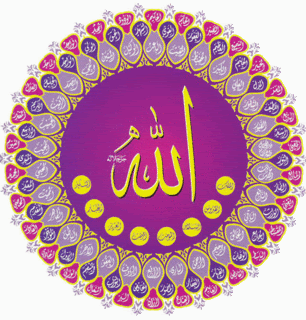
The 99 Names of Allah


Image of the 99 names of Allah
Taken from:
flickr.com/photos/43046235@N00/122799318/


Islam, along with Christianity and Judaism are all monotheistic [mono-thee-is-tic] religions; they belive in just one God.

In Islam God is called 'Allah' [aAH-lah] and has at least 99 names. There is no exact list, just a compilation from references in the Qur'an and Sunnah and over time it has became a custom to recite the entire list.


Image of the 99 names of Allah
Taken from:
http://i160.photobucket.com/albums/t175/yutclambake/gods/allah_99_names.gif


Some Misbahs, or prayer beads {see future blog archive: } contain 99 beads for this reason - one name is recited for each bead. Below, in phonetical alphabetical order, are the 99 names of Allah, with explainations:

1. Al-Ḍārr; the distressor, the harmer, the afflictor
2. Al-Adl; the utterly just
3. Al-Afuww; the pardoner, the effacer of sins
4. Al-Aḥad; the one, the all inclusive, the indivisible
5. Al-Akhir; the last
6. Al-Alīm; the all knowing, the omniscient
7. Al-Aliyy; the sublimely exalted
8. Al-Awwal; the first
9. Al-Aẓīm; the magnificent, the infinite
10. Al-Aziz; the almighty, the self sufficient, the most honorable
11. Al-Badī; the incomparable, the originator
12. Al-Bāith; the raiser of the dead
13. Al-Bāqi; the ever enduring and immutable
14. Al-Bāri'; the rightful
15. Al-Barr; the most kind and righteous
16. Al-Baṣīr; the all seeing
17. Al-Bāsiṭ; the expander, the munificent
18. Al-Bāṭin; the hidden, the all encompassing
19. Al-Fattāh; the opener, the victory giver
20. Al-Ghaffār; the ever forgiving
21. Al-Ghafūr; the all forgiving
22. Al-Ghaniyy; the all rich, the independent
23. Al-Hādi; the guide
24. Al-Ḥafīẓ; the preserver
25. Al-Ḥakam; the judge, the arbitrator
26. Al-Ḥakīm; the wise
27. Al-Ḥalīm; the forbearing, the indulgent
28. Al-Hamid; the all praiseworthy
29. Al-Ḥaqq; the truth, the real
30. Al-Ḥasīb; the bringer of judgment
31. Al-Ḥayy; the ever-living
32. Al-Jabbār; the powerful/ irresistible/compeller, the restorer/improver of affairs
33. Al-Jalīl; the majestic
34. Al-Jāmi; the gatherer, the unifier
35. Al-Kabīr; the great
36. Al-Karim; the bountiful/ generous
37. Al-Khabīr; the all aware/ knowing
38. Al-Khāfid; the abaser
39. Al-Khāliq; the creator
40. Al-Laṭīf; the subtly kind
41. Al-Majīd; the all glorious
42. Al-Mājid; the illustrious, the magnificent
43. Al-Malik; the king/ sovereign
44. Al-Māni; the withholder/ shielder/ defender
45. Al-Matīn; the firm/ steadfast
46. Al-Mu'akhkhir; the delayer, he who puts far away
47. Al-Mubdi;' the producer, originator, and initiator of all
48. Al-Mudhill; the giver of dishonour
49. Al-Mughni; the enricher, the emancipator
50. Al-Muhaymin; the guardian, the preserver, the overseeing protector
51. Al-Muḥṣi; the accounter/numberer of all
52. Al-Muḥyi; the giver of life
53. Al-Muīd; the reinstater who brings back all
54. Al-Muizz; the giver of honour
55. Al-Mujīb; the responsive, the answerer
56. Al-Mu'min; the guarantor, the self affirming, the granter of security, the affirmer of truth
57. Al-Mumīt; the bringer of death, the destroyer
58. Al-Muntaqim; the avenger
59. Al-Muqaddim; the expediter, he who brings forward
60. Al-Muqīt; the nourisher
61. Al-Muqsiţ; the equitable, the requiter
62. Al-Muqtadir; the all determiner, the dominant
63. Al-Muṣawwir; the fashioner of forms
64. Al-Mutāali; the self exalted
65. Al-Mutakabbir; the tremendous
66. Al-Qābid; the restrainer, the straightener
67. Al-Qādir; the all able
68. Al-Qahhār; the all compelling subduer
69. Al-Qawwiyy; the strong
70. Al-Qayyūm; the self subsisting sustainer of all
71. Al-Quddūs; the most holy, the most pure, the most perfect
72. Al-Wadūd; the loving, the kind one
73. Al-Wahhāb; the bestower
74. Al-Wāḥid; the one, the unique, manifestation of unity
75. Al-Wājid; the perceiver, the finder, the unfailing
76. Al-Wakīl; the trustee, the dependable
77. Al-Wāli; the patron
78. Al-Waliyy; the protecting friend, patron and helper
79. Al-Wārith; the heir, the inheritor of all
80. Al-Wāsi; the vast, the all encompassing
81. An-Nāfi; the propitious, the benefactor
82. An-Nūr; the light
83. Ar-Rāfi; the exalter
84. Ar-Rahīm; the most merciful, the most merciful in actions
85. Ar-Rahmān; the all beneficent, the most merciful in essence, the compassionate, the most gracious
86. Ar-Raqīb; the watchful
87. Ar-Rashīd; the guide, infallible teacher and knower
88. Ar-Ra'ūf; the compassionate, the all pitying
89. Ar-Razzāq; the ever providing
90. Ash-Shahīd; the witness
91. Ash-Shakūr; the grateful
92. Aṣ-Ṣabūr; the patient, the timeless
93. As-Salām; the peace and blessing, the source of peace and safety, the most perfect
94. Aṣ-Ṣamad; the self sufficient, the impregnable, eternally besought of all, the everlasting
95. As-Samī; the all hearing
96. At-Tawwāb; the ever returning, ever relenting
97. Aẓ-ẓāhir; the manifest, the all victorious
98. Dhū-l-Jalāli wa-l-'ikrām; the lord of majesty and generosity
99. Mālik-ul-Mulk; the owner of all sovereignty


Image of the 99 names of Allah.
Taken from:
http://www.geocities.com/abidaly/99namesa.gif


Personal Names
According to Islamic tradition no one except God can be called any of the names above. Boys will have the prefix, 'Abd' (servant/slave of God) placed in front of their name in order to use it.

For example, al-Samad [al sam-mad] becomes AbdSamad [ab-dul-sam-mad] and can be written; Abdulsamad, AbdulSamad, Abdul Samad, AbduSamad or AbdSamad.


Monday, January 5, 2009

The Arab Future; IBM

The three little words used for defining the future are known as, inshala [in-shaa-lah], bukra [book-rrah] and malesh [maa-a-lesh] or alternatively, and maybe unfortunately, 'IBM'.

These three little words have been known to strike terror into the heart of the most hardened expat ~me~ but they are a daily feature of life in the Middle East.


The word, Inshalla, written in Arabic


Inshala, also spelt, Inshalla [in-shAAA-lah]
Translation:
If Allah (God) wills/ when Allah (God) wills/ if Allah (God) wishes.

Meaning:
If it can be done tomorrow it is very likely it will be done tomorrow, the day after tomorrow, the day after that, the next one, or even the one after that. Apparently similar in attitude to the Spanish word, 'Mañana', where there appears to be little sense of urgency.


Bukra [book-rrah]
Translation:
Tomorrow. Also, baad bukra [baa-ad book-rrah] after tomorrow, but better to hear this, than the inevitable Inshalla

Meaning:
Unlikely to be happening any time soon


Malesh [maa-a-lesh]
Translation:
Never mind/ it’s not important

Meaning:
Likely to be uttered where it doesn't matter to the person who's messed up, but it does to the person who's been messed around.


Sunday, January 4, 2009

The Ode of Tarafah


Today I wanted to write something completely different and so am posting, 'The Ode to Tarafah', a pre-Islamic ‘hung’ poem (as in, 'hung up for all to see') taken from the, 'Anthology of Islamic Literature' edited by James Kritzeck, 1964

In 1949, Philip Hitti, wrote in his book, ‘The History of the Arabs’,
“No people in the world manifest such enthusiastic admiration for literary expression and are so moved by the word, spoken or written, as the Arabs … The rhythm, the rhyme, the music, produce on them the effect of what they call ‘lawful magic’ " [sihr ha-lal].

The Ode is about riding your camel, with your tribe, in a desperate attempt to forget your love who has remained in the desert camp.


The Ode of Tarafah
A young gazelle there is in the tribe, dark-lipped, fruit-shaking,
flaunting a double necklace of pearls and topazes,
holding aloof, with the herd grazing in the lush thicket,
nibbling the tips of the arak-fruit, wrapped in her cloak.
Her dark lips part in a smile, teeth like a comomile
on a moist hillock shining amid the virgin sands,
whitened as it were by the sun's rays, all but her gums
that are smeared with colyrium -- she gnaws not against them;
a face as though the sun had loosed his mantle upon it,
pure of hue, with not a wrinkle to mar it.

Ah, but when grief assails me, straightway I ride it off
mounted on my swift, lean-flanked camel, night and day racing,
sure-footed, like the planks of a litter; I urge her on
down the bright highway, that back of a striped mantle;
she vies with the noble, hot-paced she-camels, shank on shank
nimbly plying, over a path many feet have beaten.
Along the rough slopes with the milkless shes she has pastured
in Spring, cropping the rich meadows green in the gentle rains;
to the voice of the caller she returns, and stands on guard
with her bunchy tail, scared of some ruddy, tuft-haired stallion,
as though the wings of a white vulture enfolded the sides
of her tail, pierced even to the bone by a pricking awl;
anon she strikes with it behind the rear-rider, anon
lashes her dry udders, withered like an old water-skin.
Perfectly firm is the flesh of her two thighs--
they are the gates of a lofty, smooth-walled castle--
and tightly knit are her spine-bones, the ribs like bows, her
under neck stuck with the well-strung vertebrae,
fenced about by the twin dens of a wild lote-tree;
you might say bows were bent under a buttressed spine.
Widely spaced are her elbows, as if she strode carrying the two
buckets of a sturdy water-carrier;
like the bridge of the Byzantine, whose builder swore
it should be all encased in bricks to be raised up true.
Reddish the bristles under her chin, very firm her back,
broad the span of her swift legs, smooth her swinging gait;
her legs are twined like rope untwisted; her forearms
thrust slantwise up to the propped roof of her breast.
Swiftly she rolls, her cranium huge, her shoulder-blades
high-hoisted to frame her lofty, raised superstructure.
The scores of her girths chafing her breast-ribs are water-courses
furrowing a smooth rock in a rugged eminence,
now meeting, anon parting, as though they were
white gores marking distinctly a slit shirt.
Her long neck is very erect when she lifts it up
calling to mind the rudder of a Tigris-bound vessel.
Her skull is most like an anvil, the junction of its two halves
meeting together as it might be on the edge of a file.
Her cheek is smooth as Syrian parchment, her split lip
a tanned hide of Yemen, its slit not best crooked;
her eyes are a pair of mirrors, sheltering
in the caves of her brow-bones, the rock of a pool's hollow,
ever expelling the white pus more-provoked, so they seem
like the dark-rimmed eyes of a scared wild-cow with calf.
Her ears are true, clearly detecting on the night journey
the fearful rustle of a whisper, the high-pitched cry,
sharp-tipped, her noble pedigree plain in them,
pricked like the ears of a wild-cow of Haumal lone-pasturing.
Her trepid heart pulses strongly, quick, yet firm
as a pounding-rock set in the midst of a solid boulder.
If you so wish, her head strains to the saddle's pommel
and she swims with her forearms, fleet as a male ostrich,
or if you wish her pace is slack, or swift to your fancy,
fearing the curled whip fashioned of twisted hide.
Slit is her upper lip, her nose bored and sensitive,
delicate, when she sweeps the ground with it, faster she runs.
Such is the beast I ride, when my companion cries "Would I might ransom you, and be ransomed, from yonder waste!"
His soul flutters within him fearfully, he supposing
the blow fallen on him, though his path is no ambuscade.
When the people demand, "Who's the hero?" I suppose
myself intended, and am not sluggish, not dull of wit;
I am at her with the whip, and my she-camel quickens pace
what time the mirage of the burning stone-tract shimmers;
elegantly she steps, as a slave-girl at a party
will sway, showing her master skirts of a trailing white gown.
I am not one that skulks fearfully among the hilltops,
but when the folk seek my succor I gladly give it;
if you look for me in the circle of the folk, you'll catch me.
Come to me when you will, I'll pour you a flowing cup,
and if you don't need it, well, do without and good luck to
you!
Whenever the tribe is assembled you'll come upon me
at the summit of the noble House, the oft-frequented;
my boon-companions are white as stars, and a singing-wench
comes to us in her striped gown or her saffron robe,
wide the opening of her collar, delicate her skin
to my companions' fingers, tender her nakedness.
When we say, "Let's hear from you," she advances to us
chanting fluently, her glance languid, in effortless song."


Saturday, January 3, 2009

Addan; the Call to Prayer


Muslims pray five times a day {see blog archive: the 5 pillars of Islam } at dawn, midday, the middle of the afternoon, at sun set and about two hours after sun set.

Each time the faithful are called to prayer by the sound of the Muezzin [mez-zin], a man who recits the call to prayer or the Addan, (also spelt Azan and Athan, but all said in the same way: [add-DH'aan]).

Before electricity the Muezzin would to climb to the top of one of the minerets (the tall structure at the corner of a mosque) and call for prayer. Now a loud speaker ~sometimes a very loud speaker~ carries the message.

The Addan is thought to have started back in the time of the Prophet Mohammed. There are two points of view on this, the Sunni and the Shiite {see future blog: }. Sunnis belive a converted Ethiopian slave, Bilal ibn Rabah, climbed a wall and started to call belivers to prayer, whilst Shias believe the Prophet Mohammed was the person who started the call to prayer.


The Addan
It took me quite some time to work out what was being said in the Addan and, in reality, I had to have some help from a native speaker to hear the words. For this blog I've tried to include both the Arabic and all the relevant translations to make it as simple as possible.

I think it helps to read the words and listen to a recording at the same time suggest you try listening to:
http://www.youtube.com/watch?v=EAvlimEYEpQ.


ALLAHO AKBAR
(Allah is the greatest/most great)

ALLAHO AKBAR

ALLAHO AKBAR

ALLAHO AKBAR

ASH-HADU AL-LA ILAHA ILLALLAH
(I testify/ bear witness there is no deity but Allah/ there is none worthy of being worshipped except Allah)

ASH-HADU AL-LA ILAHA ILLALLAH

ASH-HADU AN-NA MOHAMMADAR RASULULAH
(I testify/ bear witness Mohammed is the messenger of God)

ASH-HADU AN-NA MOHAMMADAR RASULULAH

HAYYA ALAS SALAH
(Come to prayer/ Make haste towards prayer)

HAYYA ALAS SALAH

HAYYA ALAL FALAH
(Come and gain your goodness/ success/ welfare)

HAYYA ALAL FALAH

ALLAHO AKBAR
(Allah is the greatest/ most great)

ALLAHO AKBAR

LA ILAHA ILLALLAH
(There is no deity but Allah/ there is none worthy of being worshipped except Allah)


Additional Information
1 - In Saudi Arabia all business' close for about 30 minutes for each of the calls to prayer, however this does not happen in the other Gulf states.
2 - As a custom, the Addan is supposed to be the first thing a new born baby hears.


Thursday, January 1, 2009

Hand Gestures


It seems Arabs tend to use their hands extensively when they communicate. Some of the emotions indicated by these hand movements are listed below:

Beautiful
The end of your thumb and the end of your first finger touch and make a circle. The other three fingers are held out straight. The hand is then moved towards the head from the elbow.

Calm down, be patient, slower
Hold your right hand out, palm facing upwards. Bring your thumb and the tips of your fingers together, so they are above your palm, then move your hand up and down.

Come here
Hold your right hand out with your palm facing down, then move your fingers back and forth.

Give it to me
Hold your right hand out palm upwards, then close your hand halfway.

Go away
Hold your right hand out palm downwards, and move your fingers as if brushing something away from you.

Greeting someone with respect or sincerity
After shaking hands, place your right hand over your heart or chest. In addition you may kiss their forehead.

No never
Hold your right forefinger up and move it quickly from left to right several times (like a windscreen wiper).

Quieten down
Holding your right hand out, palm downwards and move it up and down slowly.

Why? What?
Holding your right hand out palm downwards, then quickly twist your hand to show your palm. forefingers point forward, whilst fingers 2, 3 and 4 should be slightly bent.

Ugliness
Hold your palm upwards and open all your fingers. Now turn your hand clockwise and then back anti-clockwise. The thumb should be slightly bent and sitting over the palm.

Very good, I’m winning
Make a fist with your right hand, whilst keeping your thumb extended upwards.


Holding Hands in Public
Arab men do hold hands with each other in public, whereas women in general don't. Occasionally you’ll see an Arab couple (man and woman) walking in the street and holding hands, but it is only occasionally. Public displays of affection are definately frowned upon and should be kept for the home.


Urban Legend
One of my students was shocked when I told him English men never held hands with each other. “But why ever not?” he asked.
I explained it would be considered un-masculine, but he wasn’t convinced,
“But what, even if they only hold hands for a minute?”
“Definitively not.” I replied.
“Umm” and then he thought some.
“But why? What are they doing wrong? They’re just being friends, that’s what friends do.”


Wednesday, December 31, 2008

Muharram


The Muhuarram Festival, c. 1795
Image taken from:www.columbia.edu

Yesterday or today, depending on whether you’re Sunni or Shiite {see wgaw: creeds of islam}, was/is New Year’s Day and the first day of the Islamic year, 1430 H {see wgaw: calendars}.

Muharram is the first month of the Islamic calendar and can also be spelt; Muharam, Moharam or Moharram, but all four versions are said in exactly the same way [moo-ha-rram].

On the 10th day of Muharram, a day of mouring known as Ashora, (also spelt Ashura, but said in exactly the same way [ash-shore-rrah], from the Arabic word for '10'; ash-rra), Shiia Muslims mourn the anniversary of the Battle of Karbala (a town about 100km south-west of Baghdad).

At the Battle of Karbala, Hussain ibn Ali (a grandson of the Prophet Mohammed, founder of Islam) and approximately 72 members of his immediate family and followers were killed, en masse in AD 680 / 61 H. It is said the survivors, mostly women and children, were transported to Damascus where they were incarcerated.


Photograph of a Muharram procession in Baroda (Vadodara) taken by an unknown photographer in c. 1880 Image taken from: http://www.bl.uk/onlinegallery

The Battle of Karbala is marked throughout the Shi'ia world during the first 10 days of Muharram with entire male populations of villages marching as one, in commemeration. Horses often lead the procession and are decorated with green and gold garlands around their necks.


Muharram in Bahrain, 2005.
Image taken from: www.wikimedia.org

The horses are closely followed by several drummers and men carrying various portable loud speakers, on which the story of the battle is re-told to the audience. Highly decorated tazivas [taa-zee-vaas] or lifesize replicas of the martyr’s coffin can follow and are carried through the streets on the shoulders of the mourners.


Muharram in Bahrain, 2005.  Image taken from: www.wikimedia.org

Next come the mourners, all male and all of whom will be dressed from head to toe in the black of mourning. They will, in unison, beat their breasts, arms and backs with their right arm. Alternatively sharp knives, 'cats of nine tails' [sun-gal] and swords [safe] are used to draw blood.

~As an aside, the only time I spectated at a Muhrram procession many years ago, there appeared to be a lot of slashing, blood and I found the smell quite overpowering (embarassingly, I fainted). So I have dilerately choosen not to add photos of bodies being cut with sharp implements to this particular blog, however, hundreds of photos can be found on the google search engine. Go to the 'image' section and type in the word 'Muharram'.

The mourning period for Ashora is 40 days, as is the custom in the Arab world {see future blog: }. During this time, within the Shi'ia communities in Bahrain, Iran, Iraq and Pakistan, you'll be able to hear speeches from the Matams [maa-taams] or the Shi'ite mourning temples, see public processions and a great pouring of public grief. Both men and women chant and weep, mourning Hussain, his family and his followers.


What to Say
Leading up to the 10th Muharram, or Ashshoora, you can use the term, "Maa jouren" [maa jou-rreen] which translates as, sympathy/ condolences.


Tuesday, December 30, 2008

Shaking Hands

photo taken from: www.flickr.com/photos/wazari/2709020340/

In general, and as an alternative to western norms, Arabs prefer a gentle handshake rather than a firm grip. The reason being it is thought that firm grip suggests unnecessary aggressiveness.

Once inside the room you should shake hands with the most senior person first who will usually, but not always, be the host. You should then work your way around the room, shaking hands and kissing each person before sitting down and joining in the conversation. I’ve read you should move around the room in an anti-clockwise direction, but I never remember which way to go round a room and am presuming it doesn't matter that much.


Urban Legends
1
Some Arabs, both male and female, will never shake the hands of an unrelated member of the opposite sex. As a woman I overcome this by waiting for the man to offer his hand to be shaken. However, sometimes I forget and hold out my hand and find it refused. I'm not particularly keen on standing in public with my arm out-stretched, hand open in mid air, waiting for a hand which is not forthcoming. It's not particularly inspiring or amusing, but I do find it less embarrassing than I used to, however it still has the capacity to make me feel quite uncomfortable.


Photo taken from: AP Photo/Amr Nabil, as shown on: alphabetcity.blogspot.com/2007_04_01_archive.html


2
When I once asked an Arab business woman why she wouldn’t shake hands with men, or why ladies wore a black glove on their right hand when they knew they were going to shake hands, her reply was,
"Well, if I were to let a man shake my hands he could easily tickle my palm, or hold it for just that bit too long. And I know he would want sex.”

She continued,
“I do shake hands with members of the opposite sex because of my work. I know Europeans would find it very rude if I didn’t shake their hands, but if I can get away with not doing it, I will.”

When I contemplated out loud I’d never thought of shaking hands in that way before she replied, “Well now you have thought about it, you’ll always have it in your mind a man can indicate how he feels about you through shaking your hand.” ~I'm still not convinced!~

3
I was out with my husband and a very close friend of his. The friend was talking about his problems and the difficulties he was currently facing. Instintively I put out my hand to touch his and was surprised to feel him pull it away quickly. Not only did he pull his hand away, he pulled his entire body away too.

It took me several seconds to realise we'd approached what I had done from completely different viewpoints: I’d reached out to him and attempted to pat him on the hand saying, “It’ll be all right” and he’d reacted as entirely appropriately; there was no way he should, in any circumstances, be touching any body part which belonged to his friend’s wife.

4
A western friend told me this story,“I remember before we got married my husband and I had male acquaintances who we would chat with. However, when we got married some of them started to shake hands with my husband and completely ignore me. I asked my husband why this was happening and he explained they were showing respect for him by ignoring me!”