Saturday, February 26, 2011

Hilter & the Bahrain Grand Prix 2011

A parody and hopefully some light relief in a very stuck situation (the youbtube does contain swearing).

BTW, would someone please tell me why the international media still continue to call the Pearl Roundabout 'Pearl Square'? Sounds like some international conspiracy ...

Friday, February 18, 2011

Bahrain Protests

For days I have wanted to write something about what is happening in Bahrain, but am finding it impossible to put my feelings of sadness into words.

Right now, like many others I am watching, waiting and wondering what on earth will happen next.

Dear Universe,
Please bless Bahrain with good energy, to bring healing and balance to this beautiful Island and its special people, physically, emotionally, mentally and spiritually. Thank You.
Amen x

Sunday, January 23, 2011

What is the Difference Between Arabs and Iranians?

Maz Jobrani is an Iranian-born, American comedian {see: MAZ JOBRANI} and forms part of the comedy group, 'Axis of Evil' {see: AXIS OF EVIL}

Jobrani's jokes focus on race, while outwardly poking fun at his own ethnic group, Iranians.

Here he explains the differences which exist between Arabs and Iranians, from his point of view:


Friday, January 21, 2011

Mecca's Metro MM

The city of Mecca has installed a rail system, known as 'Metro Mecca', using Chinese built trains with the aim of easing crowding for the approximately 2.5 million Hajj pilgrims who visit each year (the world's largest annual gathering of people).

During its first phase, Mecca Metro will link Mecca to Mina, Mount Arafat, and Muzdalifa, the holy sites visited by pilgrims retracing the steps of the Prophet Muhammad and Abraham {see wgaw: WHAT ARE THE OBLIGATIONS OF HAJJ?} 


One of the 12 lime green trains built to ease congestion of the 2.5 million pilgrims


According to the Associated Press the 18 km railway is currently only open to GCC nationals. Later in 2011, when the system becomes fully operational, non-GCC nationals will be able to ride the trains.


Men ride the newly opened Mecca Metro, November 2010


The US$2 billion rail system is currently operating at around 35 percent capacity; there are around 12 lime green trains, each of which can carry approx. 3,000 people. It is thought when the system is fully operational, later in 2011 around 500,000 pilgrims will be transported around Mecca using Metro Mecca.


Information and photos taken from the National Geographic, November 17, 2010

Tuesday, January 11, 2011

Saffron, Zaffron


"Your lips drop sweetness like honeycomb, my bride,
syrup and milk are under your tongue,
and your dress had the scent of Lebanon.
Your cheeks are an orchard of pomegranates,
an orchard full of rare fruits,
spikenard and saffron, sweet cane and cinnamon." 

Song of Solomon


Saffron [saf-fron] the spice used in oh-so-many Arabic dishes, originates from the saffron crocus, a plant which bears just three stigmas.

Described as tasting like metallic honey with grassy or hay-like notes, fresh saffron stamens are vivid crimson in colour, contain a slight moistness and elasticity. The stamens are picked and once dried are added to food and textiles to produce a rich luminous yellow-orange colour:


Cost
Saffron has long been the world's most expensive spice and is sold by weight. Saffron prices range from around US$1,100 /kg (wholesale) to US$11,000 /kg (retail), equvialent to £5,500 or €7,500 per kilogram. Saffron costs £3.80 for a ½ gram in one UK supermarket, which translates into £7,600 per kilo


"A man who is stingy with saffron is capable of seducing his own grandmother."

Norman Douglas,
English Writer (1868-1952)


Picking Saffron
Half a kilo of dry saffron requires the picking of 50,000 to 75,000 flowers (about the size of a football field)


and is said to take around 20 hours. Stigmas are picked, dried and then stored in airtight containers.


Saffron is graded by crocin (colour), picrocrocin (taste), and safranal (fragrance). Additional extras such as, 'floral waste content' and inorganic material for example, 'ash' also dertmine the grade.

Grading standards are set by the International Organization for Standardization, with ISO 3632 being used only to describe saffron's colour intensity.


Location
Most saffron is grown in an area of land which streches from the Mediterranean to Kashmir. Around 300 tonnes of saffron are produced worldwide each year, with Iran having the largest harvest (94 percent of world production).

America, Spain, Morocco, Italy, Greece, Azerbaijan, India and China all produce saffron too, see map below:


N.B. the darker the colour red, the more saffron is grown (pink indicates very small quantities)


Saffron in Food
Saffron is widely used to flavour rice and meat dishes in Iranian (Persian), Arab, Central Asian, Pakistani, Indian and Turkish food, with various methods being used to extract the colour and flavour:

1 - toast; dry roast the saffron and then soak in warmed milk for about half an hour, but this can be extended to two hours. Infusion is then added to the dish
2 - soak; add saffron to warm water for about half an hour and then tip the entire contents into the food/dish
3 - add the stamens to the food directly.


"I must have saffron to colour the warden pies;
mace; dates? none, that's out of my note;
nutmegs, seven; a race or two of ginger,
but that I may beg;
four pound of prunes, and as many of raisins o' the sun."
William Shakespeare (1564-1616)
Act IV, scene III, 'The Winter's Tale'


Saffron Rice
2 cups basmati rice
1 teaspoon saffron threads + 3 tablespoons boiling water
6 tablespoons butter
several cinnamon sticks
1 cup finely chopped onion (fried until golden)
2 teaspoons salt
6 - 8 cardamoms, cracked open


Place the saffron in a small bowl and cover with 3 tablespoons of boiling water. Soak for 30 minutes.

Wash rice until the water runs clear {see wgaw: COOKING RICE CAN TAKE SOME TIME}, put in boiling water and wait until the rice is just past al-dente.

While the rice is cooking, saute the onions until they turn slightly brown (golden)

Boil the rice until it is almost soft, but has a slightly hard bit in the middle. Remove the rice from the ring and put in a sieve. Wash the rice with cold water to stop it cooking

Dry the saucepan and add butter, ghee or margarine to the bottom of the pan and put on the ring to warm.  Add the cardamons, cinamon and the saffron and its soaking water

When the fat is melted, put the rice in the pan and warm on a low heat for an hour or so

Fluff and serve hot.


Saffron Tea
Tea is brewed as normal; tea is placed in a tea pot, however the smallest ammount of saffron is infused with the tea leaves.  Brew for upto 20 minutes and pour into small glass tea cups, with sugar being added to taste.  Leave the saffron threads in the liquid.


Storing Saffron
Because saffron is sensitive to light and moisture it should be stored in a container away from sunlight. Saffron easily absorbs other flavors and odours - be sure to clean any container before you use it to store saffron.


Historical Uses of Saffron
Saffron-based pigments were used as dyes and have been found in 50,000 year-old cave paintings in in Iran and Iraq.  Saffron has also been used as a fabric dye; Buddhist monks in India adopted saffron-coloured robes. However, the robes were not dyed with costly saffron but turmeric, a less expensive dye, or jackfruit.

Saffron threads would be scattered across beds and mixed into hot teas as a curative for bouts of melancholy. Historically, saffron's use as a drugging agent and aphrodisiac were feared.

During his Asian campaigns, Alexander the Great used saffron in his baths as a curative for battle wounds. Alexander's troops imitated the practice
Medicinally saffron has long been part of the traditional healing tradition; Sumerians used saffron in their remedies and magical potions.

Apparently modern medicine uses saffron as both an anticarcinogenic (cancer-suppressing) agent, as well as an anti-mutagenic (mutation-preventing).  Early studies show that saffron may protect the eyes from retinal stress and slow down macular degeneration.


Saffron Translated
Arabic 'Zaferan'
Farsi 'Zefrun' (in Persian,'zarparan' means a flower with a stigma which has a value equvialent to gold)
French 'Safrane'
Indian 'Zuffron'
Italian 'Zaferano'
Spanish 'Azafran'
Tamil 'Gnaazhal poo'
Turkish 'Zefrun'

Thursday, January 6, 2011

Hajj 1953 - around Jeddah


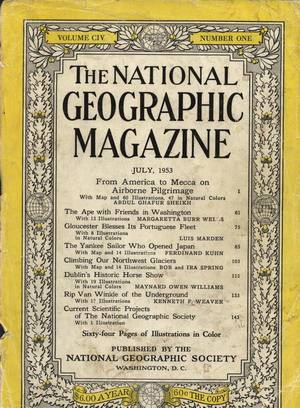
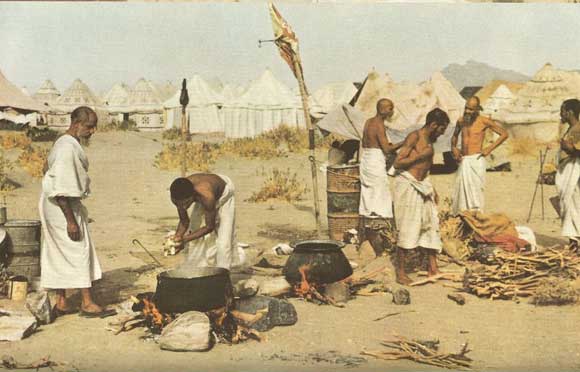
Here is the final set of photographs from the July 1953 edition of the National Geographic magazine, showing areas of Jeddah during the Hajj


Sunday, January 2, 2011

Hajj 1953 - Praying

Again, more images from the National Geographic from 1953. This time the photos show images of pilgrims praying in Mecca. I've also included a National Geographic video from YouTube which explains what happens when a person goes on the Hajj {see wgaw: HAJJ}.

A Muslim man who has completed the obligatory Hajj is known as Hajji [Haj-jee] whilst a Muslim woman is known as Hajjia [haj-jee-ah]


Sunday, December 26, 2010

Hajj 1953 - Pilgrims

Here are some more photos from the 1953, courtesy of the National Geographic Magazine. This time they focus on the pilgrims:


Thursday, December 23, 2010

Hajj 1953 - transportation

The following photos, depicting the Hajj, are supposed to have been published in the National Geographic Magazine during 1953.

There's quite a few of them, so I've seperated them into various different topics and will post over the next week or so. This post deals with transportation:


Monday, December 20, 2010

The Koran, from a Western Perspective

Lesley Hazleton is a British-American writer whose work focuses on the politics, religion, and history of the Middle East.

Here are her thoughts on the Quran or Koran:


Hazleton was born in England, and became a United States citizen in 1994. She was based in Jerusalem from 1966 to 1979 and in New York City from 1979 to 1992, when she moved to her current home in Seattle WA.

She has described herself as, "a Jew who once seriously considered becoming a rabbi, a former convent schoolgirl who daydreamed about being a nun, an agnostic with a deep sense of religious mystery though no affinity for organized religion".

She blogst at: THE ACCIDENTAL THELOLOGIST and is currently working on a new biography of Muhammad, to be published by Riverhead/Viking in 2012.

Friday, December 3, 2010

Thursday, October 14, 2010

Wives of the Prophet Mohammed

For many years I had heard the Prophet Muhamed had several wives, but I was never sure how many and was very unaware of the details surrounding this fact. 

Having recently posted: MASS WEDDINGS in which the speaker (see 1:05) suggests the Prophet Mohammed married Aisha when she was 6 and consumated the marriage when she was aged 9, I thought I would check this out further (it appears to be true).

However discussing his marriage to Aisha is not the purpose of this posting - the aim is to simply list the names of the Prophet's wives - for those of us who are unsure about whom he married and in which order:

1 -Khadija bint Khawilad (aged 40, twice widowed before)

2 - Sauda bint Zama (aged 50, widow)

3 - Aisha bint Abu Bakr (aged 9)

4 - Hafsa bint Umar bin Khattab (aged 22, widow)

5 - Zainab bint Khuzaima (aged 30?)

5 - Umm-I-Salma bint Abu Umayia (aged 26, widow)

6 - Zainab Bint Jahash (aged 38, widow)

7 - Juwaeria Bint Harith (aged 20, widow)

8 - Umm-I-Habiba bint Abu Sufyan (aged 36, widow)

9 - Marya Qibtiya bint Shamun (aged 17, Egyptian)

10 - Safia bint Hayi bin Akhtab (aged 17, widow)

11 - Raihana bint Umru bin Hanafa (no details given)

12 - Maimuna bint Harith (aged 36, widow)


Here are some relevant Koranic quotes regarding marriage: 

4:3
"And if you be apprehensive that you will not be able to do justice to the orphans, you may marry two or three or four women whom you choose. But if you apprehend that you might not be able to do justice to them, then marry only one wife, or marry those who have fallen in your possession."

33:52
"It is not lawful for thee (to marry more) women after this, nor to change them for (other) wives, even though their beauty attract thee, except any thy right hand should possess (as hand maidens) and Allah doth watch over all things."

33:53
"Nor is it right for you that ye should annoy God's Apostle, or that ye should marry his widows after him at any time. Truly such a thing is in God's sight an enormity."

Saturday, September 25, 2010

Monday, September 20, 2010

The Key Difference Between Europe and the Arab World

Syrian poet, Adonis explains from his point of view the key differences between Arab and European thinking. Posted because it's an interesting viewpoint and there appear to be very few Arab public thoughts on this subject.


Monday, September 13, 2010

Basboosa - Semolina Cake

Basboosa [bas-boo-sa] or semolina cake  is a classic sweet found across the Arab world.  This particular recipe is based upon one taken from the recently published, 'Sweets of Arabia', by Egyptian sweet maker Osama El Sayed and which is published by E L Sage Associates, in VL, USA (ISBN: 9780615384184).


I've changed the recipe given by Osama into my own version of this classic Middle-Eastern sweet (indicated by the words, 'suggest' or 'rather than').  I've also changed the quantities for the ingredients into metric as the American cup system didn't seem to make any sense (I had no idea what a cup was/is, in quantity terms).

Ingredients
butter for greasing cake pan
168g [6oz, or 3/4 cup] milk (suggest substituting milk for coconut milk, according to taste)
61 g [2.15 oz, or 1/4 cup] plain yogurt
350g [12.25 oz, or 1 3/4 cups] sugar (suggest substituting some for vanilla sugar)
400g semolina [15 oz, or 2 1/2 cups] semolina flour (suggest using semolina grains for texture)
1/2 teaspoon baking powder
1 tablespoon vanilla essence (rather than the 1/2 teaspoon suggested)
100g [11 oz, or 1/3 cup] melted, clarfied butter/ghee (rather than the 1/2 cup suggested)
1 1/2 cups candided fruit (suggest adding orange zest too if making the orange flavoured version)
31g [1.1 oz, or 1/3 cup] shredded coconut (suggest using desiccated coconut for texture)


As an Alternative
1 - suggest slivered almonds and apricots for topping
2 - suggest using orange flavouring, instead of vanilla
3 - suggest adding a tiny ammount of turmeric or saffron to colour the cake
4 - a savory Indian version can be made of the cake using grated carrots, peas, green beans, grated ginger, cumin seeds, mustard seeds and sesame seeds


Methodology
Preheat the oven to 180 deg C or 350 deg F. Grease a cake pan of choice (8"x12" or individual mini-muffin cups. Warm the ghee in a saucepan so it melts, but doesn't boil.

In a large bowl combine the milk and sugar, stir together to disolve the sugar completely (suggest using an electric mixer).  In another bowl, mix the yogurt and baking soda together and leave until the yogurt has doubled in size.

Add the semolina flour and vanilla to the milk and sugar mix and stir until well combined (again, suggest using an electric mixer). Stir in the melted clarified butter/ghee and mix until smooth.

Add the yogurt and baking soda mix to the semolina, milk and sugar mix and combine. Then add the candied fruits and cocount and mix well.

Pour the batter into the prepared cake pan, ensuring the top surface is smooth. (suggest the depth of the batter is no more than 1" thick - the traditional way).

If using the 8x12 pan bake for 35 mins, if making mini muffins bake for 20 mins or until golden brown.

remove cake pans from oven and cool. Do not remove cake from tin until cool. If using the 8"x12" tin, cut in to diamond shapes. Remove from pan, place on plate and place slivered almonds and or apricots on top. If making the orange version, suggest placing slivered candided oranges on top.

This particular recipe tastes far better on day 2 or 3, rather than being eaten hot straight from the oven.

Tuesday, August 24, 2010

Arabic Shortbread

Nochodchi [no-cho-chee] is chickpea flour made into something very similar to Scottish shortbread. So, Arabic Shortbread if you will.

You'll need chickpea flour,


and icing sugar,


as well as cardamon to taste, butter to bind and split pistachios for texture and colour.  Mix all four ingredients together


and then roll up into a long sausage and put it in the fridge for up to six hours:


After it has rested find the cookie cutter,


unwrap the cold sausage of chickpea flour,


and make your cookies:


Bake them in a preheated oven 160 deg C for 30 mins and et voila, chickpea shortbread: